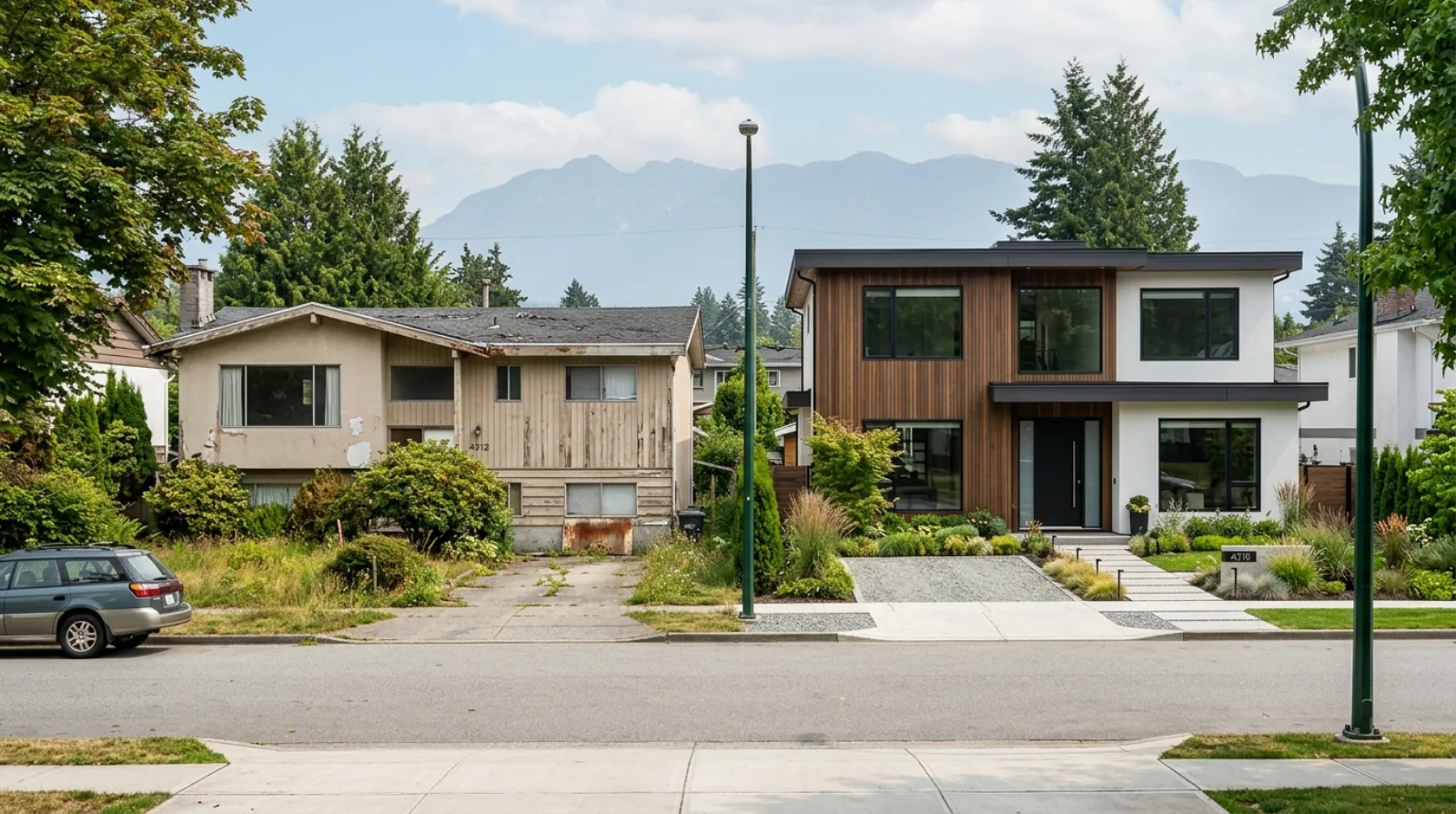
Some version of "we'll renovate it ourselves and come out ahead" has launched more buyer disappointment than almost anything else I hear in Burnaby. Sometimes it's exactly right and the fixer-upper is the smart buy. Just as often, the buyer fell for the lower sticker price without running the math on what it actually costs to make the house livable. The difference between those two outcomes is entirely in the numbers, and most people do the numbers after they've already fallen in love.
So let's do them first. Here's the honest comparison between buying a Burnaby fixer-upper and renovating versus paying up for move-in-ready in 2026 — including a third option that older Burnaby lots quietly offer.
Why the fixer looks cheaper than it is
A fixer-upper's appeal is obvious: the price is lower. What the price hides is that you're buying a home plus an obligation, and the obligation isn't priced on the listing.
The real cost of a fixer is roughly: purchase price, plus the renovation budget, plus a contingency for the things you find once the walls are open, plus the cost of carrying the home (and often your current housing) for the months the work takes. Buyers reliably underestimate the last three. The renovation budget gets optimistic, the contingency gets skipped, and nobody pencils in four to eight months of paying for two roofs over their head while the kitchen is plumbing and dust.
Move-in-ready inverts this. You pay more up front, but the number on the listing is close to the number you live with. You're buying finished work, and you skip the carrying cost, the project-management stress, and the surprises behind the drywall.
Renovation cost reality in 2026
The number that makes or breaks a fixer is the renovation budget, and in 2026 it's higher than the version in most buyers' heads. Trade labour and materials in the Lower Mainland have stayed expensive, and an older Burnaby home often needs more than cosmetics once you start.
Rough orders of magnitude to anchor on, recognizing that every house is different:
- A cosmetic refresh — paint, flooring, light fixtures, surface-level updates — is the cheapest path and the one most likely to land near budget.
- A proper kitchen or bathroom renovation moves into serious money quickly once you're touching plumbing, electrical, and cabinetry.
- A full gut — wiring, plumbing, insulation, layout changes — on an older home can approach or exceed what it would cost to build new per square foot, especially once you hit knob-and-tube wiring, old galvanized plumbing, or a foundation issue.
The trap is the gut-renovation that the buyer budgeted as a cosmetic one. An older home reveals its problems after you own it, not during the showing. Build a contingency of at least 15% to 20% on top of your renovation estimate, and treat any number a previous owner or a quick walkthrough gives you as a starting point, not a quote.
Permits — the part that adds time and cost
Most meaningful renovation work in Burnaby requires permits, and structural, electrical, plumbing, and gas work generally does. Permits exist for good reasons, but they add time, cost, and process, and skipping them creates problems that surface at exactly the wrong moment — when you go to sell, or when an inspection flags unpermitted work.
Two practical points. First, build permit timelines into your schedule; they're rarely instant. Second, unpermitted work done by a previous owner is a real risk when you buy a fixer that's already been partly renovated. If the last owner did "improvements" without permits, you can inherit the liability. Confirm what's permitted before you buy, not after. The City of Burnaby is the authoritative source for what your specific project requires.
The question older Burnaby lots force: renovate or redevelop?
Here's the part that's specific to Burnaby in 2026, and it changes the whole calculation. On an older detached lot, the right answer might not be "renovate" or "buy move-in-ready" at all. It might be "redevelop."
Under Bill 44, the provincial small-scale multi-unit housing rules, many standard Burnaby lots can now support more than one home — duplexes, triplexes, or multiplex units where the lot and zoning allow. That means an older house on a good lot is often worth more as land for redevelopment than as a renovated single home.
If that's your lot, pouring $300,000 into renovating a house you might tear down in a few years can be money lit on fire. The smarter analysis is the sell, hold, or redevelop framework: is the value in the house, or in the dirt? On a lot where the land carries the value, a light cosmetic update to make it livable or rentable while you plan a redevelopment beats a deep renovation you'll demolish. On a lot where redevelopment doesn't pencil, a quality renovation can be the right call.
This is why I don't answer "fixer or move-in-ready" without looking at the specific lot. The Bill 44 option sits underneath both and sometimes outranks them.
Financing the renovation
A fixer-upper isn't just a different price; it's a different financing problem. Lenders generally lend against the home's current condition, not its renovated potential, so you can't simply borrow the renovation cost against the finished value before the work exists. Options buyers use include a purchase-plus-improvements mortgage (where the lender advances renovation funds against an approved scope), a line of credit, or cash. Each has its own qualification and cost. Sort the financing before you commit, because "we'll figure out the reno money later" is how a fixer stalls half-finished.
When the fixer actually wins
The fixer-upper is the right buy when several things line up:
- You buy it cheaply enough that the purchase price plus a realistic renovation budget plus contingency still comes in below comparable move-in-ready homes.
- You have the cash reserves and the financing in place to carry the work without stress.
- You have the patience and the temperament for months of mess, decisions, and surprises.
- The lot doesn't have a stronger redevelopment use that makes renovating wasteful.
When those hold, you capture the gap between a discounted project home and a finished one, and you get a home renovated to your taste. When they don't — when you pay nearly move-in-ready money for a project, skip the contingency, and underestimate the timeline — the fixer is the more expensive house wearing a cheaper price tag.
Key Takeaways
- A fixer's true cost is purchase price plus renovation plus contingency plus carrying cost — buyers reliably underestimate the last three.
- 2026 renovation costs in the Lower Mainland are high; a full gut on an older home can approach the cost of building new per square foot.
- Most meaningful renovation work needs permits in Burnaby, and inheriting a previous owner's unpermitted work is a real risk.
- On an older Burnaby lot, Bill 44 may make redevelopment a better move than either renovating or buying move-in-ready — check the land value first.
- The fixer wins when you buy it cheaply enough, have cash and patience, and the lot has no stronger redevelopment use.
Frequently Asked Questions
Is it cheaper to buy a fixer-upper or a move-in-ready home in Burnaby?
It depends on how cheaply you buy the fixer. The fixer is cheaper only if the purchase price plus a realistic renovation budget plus a 15% to 20% contingency plus carrying costs still comes in below comparable move-in-ready homes. If you pay nearly finished-home money for a project, the fixer ends up more expensive.
How much should I budget for renovating an older Burnaby home?
It varies widely by scope. A cosmetic refresh is the most predictable; a kitchen or bathroom renovation costs significantly more once plumbing and electrical are involved; and a full gut on an older home can approach the cost of new construction per square foot. Always add a 15% to 20% contingency for hidden problems.
Should I renovate or redevelop an older Burnaby lot?
Check the land value first. Under Bill 44, many standard Burnaby lots can support multiple units, which can make the land worth more for redevelopment than a renovated single home. If your lot supports redevelopment, a deep renovation you might later demolish can waste money. A light update while you plan may be smarter.
Can I include renovation costs in my mortgage?
Sometimes. A purchase-plus-improvements mortgage lets some lenders advance renovation funds against an approved scope of work. Other buyers use a line of credit or cash. Lenders generally lend against the home's current condition, not its renovated potential, so arrange financing before committing to a fixer.
Sources
- City of Burnaby — Building and renovation permits
- Province of BC — Bill 44 / Small-Scale Multi-Unit Housing
- Greater Vancouver REALTORS — Monthly Market Report
Information sourced June 2026. This is general guidance, not financial or construction-cost advice. Renovation costs, permit requirements, and Bill 44 zoning rules vary by property — get specific quotes and confirm with the City of Burnaby before committing.
Related Guides
- Buying a Home in Burnaby — complete 2026 guide: First-time programs, condo vs townhome, due diligence, and neighbourhood decisions in order.
- Burnaby Multiplex Development Guide: If the land is more valuable than the house, read the zoning tiers, feasibility, and four-path decision before you commit to a renovation.
Work With Jersey Li
Whether a fixer-upper makes sense often comes down to the specific lot and whether the value is in the house or the land underneath it. Before you choose between a project home and a finished one, get a clear read on what your target property — or your current one — is really worth and what its redevelopment potential is. Request a valuation for a straight answer, or reach out directly to talk through a specific property you're considering.

Sutton Group — 1st West Realty · Medallion Club Member (Top 10%)
Burnaby real estate advisor and multiplex strategist. Licensed REALTOR® with Sutton Group — 1st West Realty, specializing in residential, multiplex, and redevelopment transactions across Burnaby and Metro Vancouver.