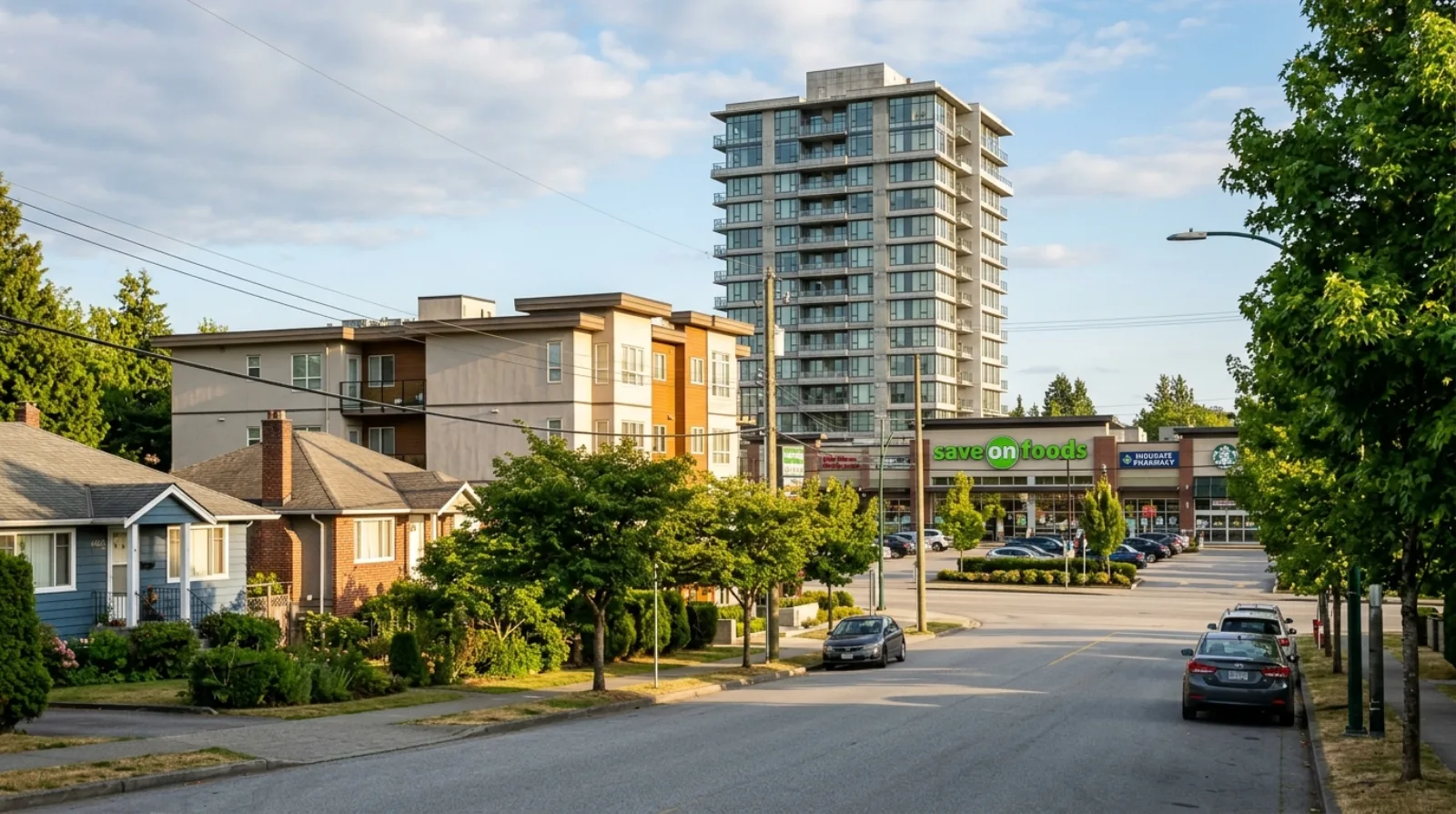
South Burnaby is the most consequential multiplex market in the Lower Mainland right now. The combination of provincial Bill 44 (the 2024 small-scale multi-unit housing legislation) and Burnaby's R1 district rezoning has converted thousands of standard single-family lots into legal multiplex sites. Under the current bylaw framework, a typical 50 by 122 foot lot in South Burnaby can support four units. Lots within 400 metres of frequent transit — most of the Edmonds and Royal Oak catchments — can support six units. Larger lots and corner lots open up additional configurations, including stacked townhouse layouts and small-format rental buildings.
The pro-forma math is what is driving activity. Land at $1.5M to $1.7M, construction at roughly $350 to $400 per square foot for a four-plex, and end values of $1.1M to $1.4M per unit means that projects pencil — not spectacularly, but enough to attract experienced builders and well-capitalized owner-occupiers. The early movers in 2024 and 2025 captured the cleanest sites: flat lots, no easements, no significant trees, simple servicing. What is left in 2026 is more mixed, and underwriting is more selective.
Servicing is the constraint nobody talks about until permits stall. Burnaby's water, sewer, and storm infrastructure in South Burnaby was sized for single-family density. Multiplex projects are triggering service upgrade requirements — new sewer connections, larger water laterals, and in some cases off-site upgrades paid for by the developer. Budget $40,000 to $90,000 per project for servicing surprises, and confirm with the city before firm-up. Parking minimums have been reduced under the new bylaws but not eliminated; most four-plex projects still need to provide one stall per unit, which constrains site layout on narrower lots.
Character-home retention is a live issue. Several streets in Suncrest and east of Royal Oak have pre-1940 homes that the city has flagged for heritage review. A retention-plus-multiplex configuration — keeping the original house and adding three or four units behind or beside it — is permitted and in some cases incentivized, but the design and construction sequencing is harder than a clean tear-down. Owners considering this path should plan for an additional six to nine months in approvals.
Neighbour disputes are increasingly common. Construction noise, parking spillover, tree removal, and shadow impacts are generating complaints to the city and, in a few cases, civil claims. None of this stops projects, but it lengthens timelines and adds soft costs. Builders with reputations for clean sites and good neighbour communication are getting referrals; the cowboys are getting flagged. If you are buying a lot to develop, factor relationship management into your project plan, not just the budget.
The honest assessment: South Burnaby multiplex is a real opportunity, not a gold rush. Margins are tight enough that execution matters more than location, and the projects that work are the ones where the buyer understood the zoning, the servicing, the design constraints, and the resale market before writing the offer. The projects that struggle are the ones bought on a thesis with no underwriting. I have walked away from sites that looked good on paper because the lane access or the storm servicing made the numbers fail. That is the work.