People ask me this a lot right now. And my honest answer is: probably yes, for the right buyer. But "good place to buy" means different things depending on what you are buying, why, and what your timeline is. Let me give you the actual read instead of a press-release version.
What the market looks like in June 2026
The data is straightforward. The Greater Vancouver REALTORS April 2026 market report shows detached benchmarks in Metro Vancouver at $1,840,700 — down 8.3% year-over-year. Apartments at $703,000, down 7.9%. Townhomes at $1,043,400, down 5.1%.
The sales-to-active ratio sits at 13.5% region-wide. Historically, below 12% signals downward price pressure, above 20% signals upward. 13.5% is balanced, leaning slightly soft. Sellers are not in control. Buyers have leverage they haven't had since 2021.
On the financing side, five-year fixed rates have come down materially from their 2023–2024 peak. The Bank of Canada's benchmark 5-year rate and the posted discounted rates from major lenders have tracked the BoC's easing cycle, with competitive five-year fixed rates in the mid-3% range as of June 2026 — meaningfully lower than the 5–6% range buyers faced in 2023 and 2024. That lowers the monthly payment on a given purchase price, which is the number that actually determines whether most people can buy.
So: prices are down, inventory is up, rates are lower. That combination hasn't existed since before the pandemic run-up.
Who 2026 is actually right for
Not everyone.
If you are a first-time buyer with a qualifying budget and a 5-10 year timeline, 2026 looks like a reasonable entry point. You are not buying at peak. You have more negotiating room. Rates are workable. And if you use the programs available to you — the FHSA, RRSP Home Buyers' Plan, and BC PTT first-time exemption — your effective upfront cost is materially lower than it appears on paper. The first-time buyer programs guide walks through what you can stack.
If you are an investor expecting short-term appreciation, the thesis is harder. Rental yields on Burnaby condos are below current financing costs in most scenarios. If you need the property to cash-flow from day one, the numbers don't work at current prices and rates. If you are buying for long-term capital appreciation with rental income as a partial offset, the story is more interesting — Burnaby has strong structural drivers (transit investment, density policy, Metro Vancouver supply constraints) that make a 10-year hold reasonable.
If you are upsizing from a condo to a detached, the move still makes sense if the price gap between what you are selling and what you are buying has narrowed — which it has, with detached prices down 8% and condos down 8% as well. The spread hasn't changed dramatically, but the absolute entry price for detached is lower than it was.
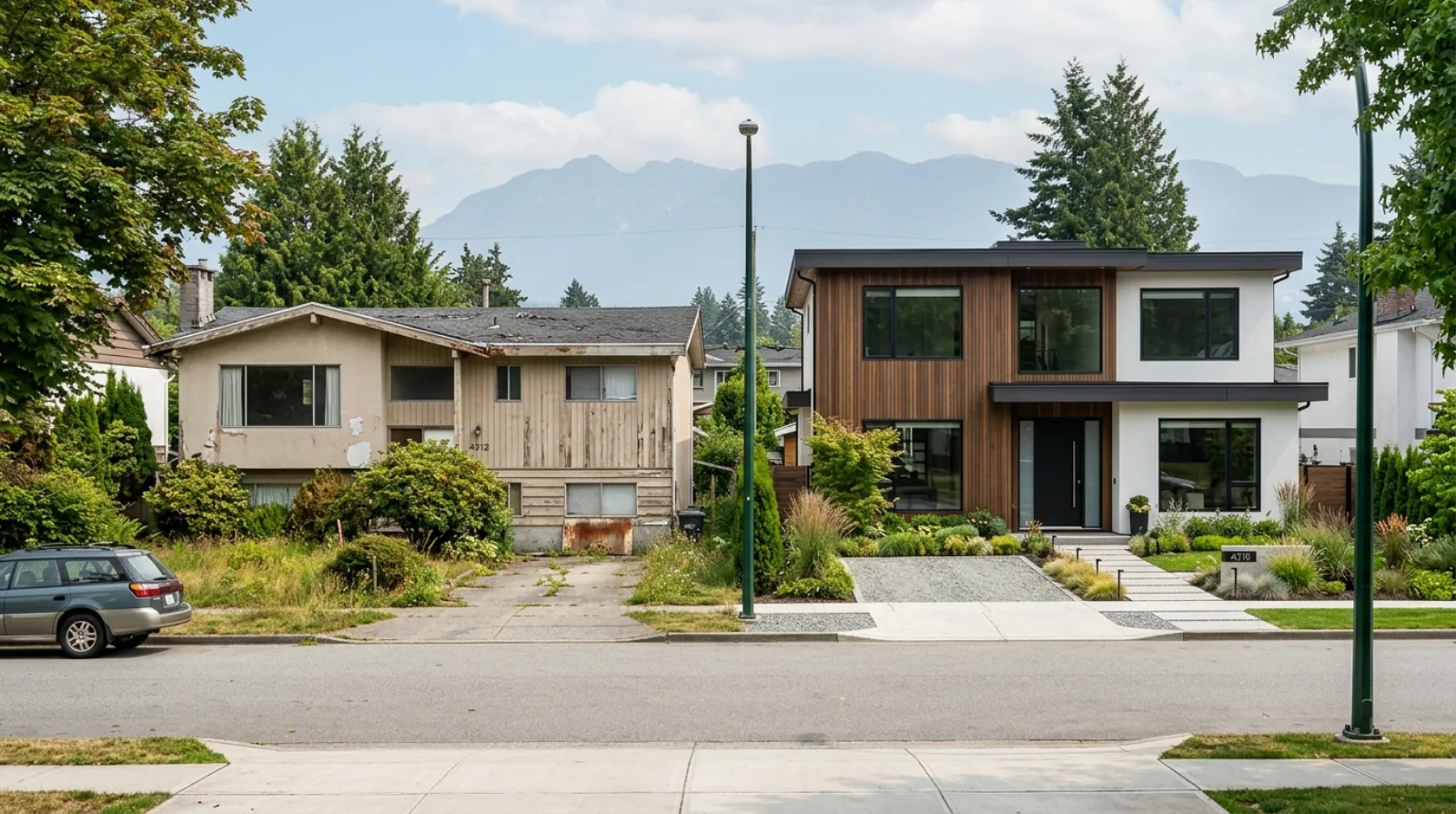
If you are buying a Burnaby detached lot with an eye toward the redevelopment upside under Bill 44, 2026 is worth taking seriously. Prices are off peak, the SSMUH zoning rules are now established, and the builder market is active. Whether you should sell, hold, or build is a separate question — the multiplex advisory covers the full decision framework.
Who each Burnaby neighbourhood suits in 2026
Within Burnaby, conditions vary considerably. The "is it a good time to buy" question looks different depending on which pocket you are targeting. Here is the honest summary across all six areas:
| Neighbourhood | 2026 Condo Entry Range | Best for | Caution |
|---|---|---|---|
| Brentwood | ~$650K–$900K (1BR) | Young professionals, Millennium Line commuters, transit-first buyers | Supply wave from new towers; absorption slower than expected in 2025–26 |
| Metrotown | ~$620K–$850K (1BR) | Stability seekers, Expo Line commuters, investors wanting depth | Prices softer YoY but resilient; fewer obvious deals vs. Edmonds |
| Edmonds | ~$550K–$780K (1BR) | Value buyers, patient investors, Expo Line users | Pre-sale insolvency examples nearby; older strata stock needs scrutiny |
| Burnaby Heights | ~$700K–$950K (1BR condo / walk-up) | Character seekers, walkability buyers, buyers who don't need SkyTrain at the door | Tighter inventory; fewer entry condos than transit cores |
| South Burnaby | ~$900K–$1.4M (townhome) | Families needing outdoor space, school-catchment buyers | Most exposure to detached correction; slower velocity |
| Deer Lake | ~$2M+ (detached only) | Privacy, heritage estate buyers, long-hold sellers | Almost no public inventory; private-market access required |
Price ranges are working estimates based on 2026 active and recent-sold data. Verify against current MLS data before relying on them.
If the goal is most space per dollar on SkyTrain, Edmonds wins the math in 2026. If the goal is the most liquid resale market with the least uncertainty, Metrotown has the track record. If you are a first-timer and Millennium Line access is a priority, Brentwood has the deepest condo selection at accessible price points, though the new supply pipeline means you are not buying into a supply-constrained environment.
What the stacked programs change for first-timers
One thing I see first-time buyers miss is the cumulative effect of stacking the available purchase programs. Each one is documented somewhere, but the combined impact is significant enough that it changes what a buyer can actually put on the table.
The BC First Home Buyers' Program exemption eliminates Property Transfer Tax on purchases up to $835,000 and provides partial relief up to $860,000. That is a saving of up to $13,000 — real money, not a rounding error.
The First Home Savings Account (FHSA) provides a tax deduction on contributions and tax-free withdrawals for a qualifying purchase, similar to the structure of an RRSP. You can contribute up to $8,000 per year and up to $40,000 lifetime. Unlike the RRSP Home Buyers' Plan, FHSA withdrawals do not need to be repaid.
The RRSP Home Buyers' Plan still applies alongside the FHSA: up to $35,000 per borrower ($70,000 for a couple) drawn tax-free from an existing RRSP, to be repaid over 15 years.
For a couple with maximised FHSAs and existing RRSP savings, the combined available funds can be substantial — and all of it avoids tax on the way out. For first-timers who have not fully used these accounts, 2026 is a reasonable year to be diligent about maximising them before a purchase.
The full program detail and eligibility guide is the right reference before any first-timer structures their down payment. If you want to run your own qualifying numbers, the mortgage calculator takes today's rates and your income and shows what you actually qualify for — useful before you start looking at specific properties.
What gives me pause
The market hasn't bottomed. I don't know that it will go materially lower, but I don't know it won't. Anyone who tells you they know where the floor is in a 13.5% sales-to-active environment is guessing.
Rental vacancy has increased — average Burnaby rents are down about 8% year-over-year per Zumper. If you are buying with a rental income assumption, discount that projection.
Pre-sale risk is real. Two Burnaby developments went into insolvency proceedings in the last 18 months — the Eclipse tower in Brentwood (reported by Business in Vancouver) and Siena at the Heights — which left buyers navigating receiver sales and delayed completions. I'd be cautious about any developer without a verified construction draw and a track record of completed buildings.
And the jobs market matters. A lot of Metro Vancouver buyers are in tech and professional services. If the employment picture deteriorates, demand can come off faster than prices seem to suggest.
The practical read
For a buyer who is ready — finances sorted, timeline clear, specific neighbourhood and type in mind — this is a reasonable market to buy in. Not the best market I've seen working Burnaby. Not the worst. A patient buyer who knows what they are buying has more options right now than they have had in a long time.
For a buyer who is not ready — pre-approval incomplete, down payment not there, or genuinely uncertain about the timeline — the worst thing to do is rush because of a fear of missing something. The market has been uncomfortable for buyers for years; taking a careful six months to get the basics right is not going to cost you the one house you wanted.
The complete buying guide walks through the sequence: programs, property type, due diligence, neighbourhood. Work through it before you make any commitments.
Key Takeaways
- Burnaby prices are down 7-8% from peak across most property types, with inventory the highest since 2021.
- The sales-to-active ratio (13.5%) puts buyers in a stronger negotiating position than at any point in the 2020-2022 run-up.
- 5-year fixed rates in the mid-3s are meaningfully lower than the 5-6% range of 2023-2024.
- 2026 is a reasonable entry point for prepared first-time buyers and long-hold investors, not for buyers expecting quick appreciation or clean cash-flow.
- Pre-sale risk has been demonstrated locally — verify developer financing before committing.
Frequently Asked Questions
Is Burnaby a good place to buy real estate in 2026?
For buyers with a 5-10 year horizon and clear finances, yes. Prices are down from peak, inventory is at multi-year highs, and rates are more workable than they were in 2023-2024. The case is weakest for short-term investors expecting quick appreciation and buyers who need rental cash-flow from day one.
Will Burnaby real estate prices go up or down in 2026?
The April 2026 sales-to-active ratio of 13.5% is balanced — neither the strong seller's market conditions that drove 2020-2022 nor the steep corrections seen in some US markets. Most forecasters project modest recovery over 12-18 months, but forecasts in a 13% ratio environment are genuinely uncertain. Buy for a timeline where the 12-month price direction doesn't matter.
What is the best Burnaby neighbourhood to buy in 2026?
It depends on your goals. For first-timers: Metrotown and Brentwood have the deepest condo selection at SkyTrain. For value and upside: Edmonds. For families: South Burnaby. For investment with a long horizon: Lougheed. The neighbourhood guide for buyers walks through the full decision.
Is it better to buy resale or presale in Burnaby in 2026?
For most first-time buyers, resale is lower-risk in 2026. You can inspect the property, review strata documents with subjects, and get a firm mortgage before committing. Two recent Burnaby pre-sale projects went into insolvency — the risks of buying from an under-financed developer are real. Presale can make sense for buyers with a long horizon buying from a financially verified developer.
Sources
- Greater Vancouver REALTORS — Monthly Market Report, April 2026
- Zumper — Average Rent in Burnaby BC, May 2026
- Bank of Canada — Mortgage Rate Data
- Business in Vancouver — Burnaby pre-sale insolvency coverage
Market data sourced June 2026. Prices, rates, and market conditions change. This is general market commentary, not investment or financial advice. Talk to a mortgage broker, financial advisor, and your REALTOR® before making any purchase decisions.
Work With Jersey Li
If you are thinking about buying in Burnaby and want a clear-eyed read on whether it makes sense for your situation, get in touch or start with a home valuation if you are also selling. No pressure — just a conversation.

Sutton Group — 1st West Realty · Medallion Club Member (Top 10%)
Burnaby real estate advisor and multiplex strategist. Licensed REALTOR® with Sutton Group — 1st West Realty, specializing in residential, multiplex, and redevelopment transactions across Burnaby and Metro Vancouver.