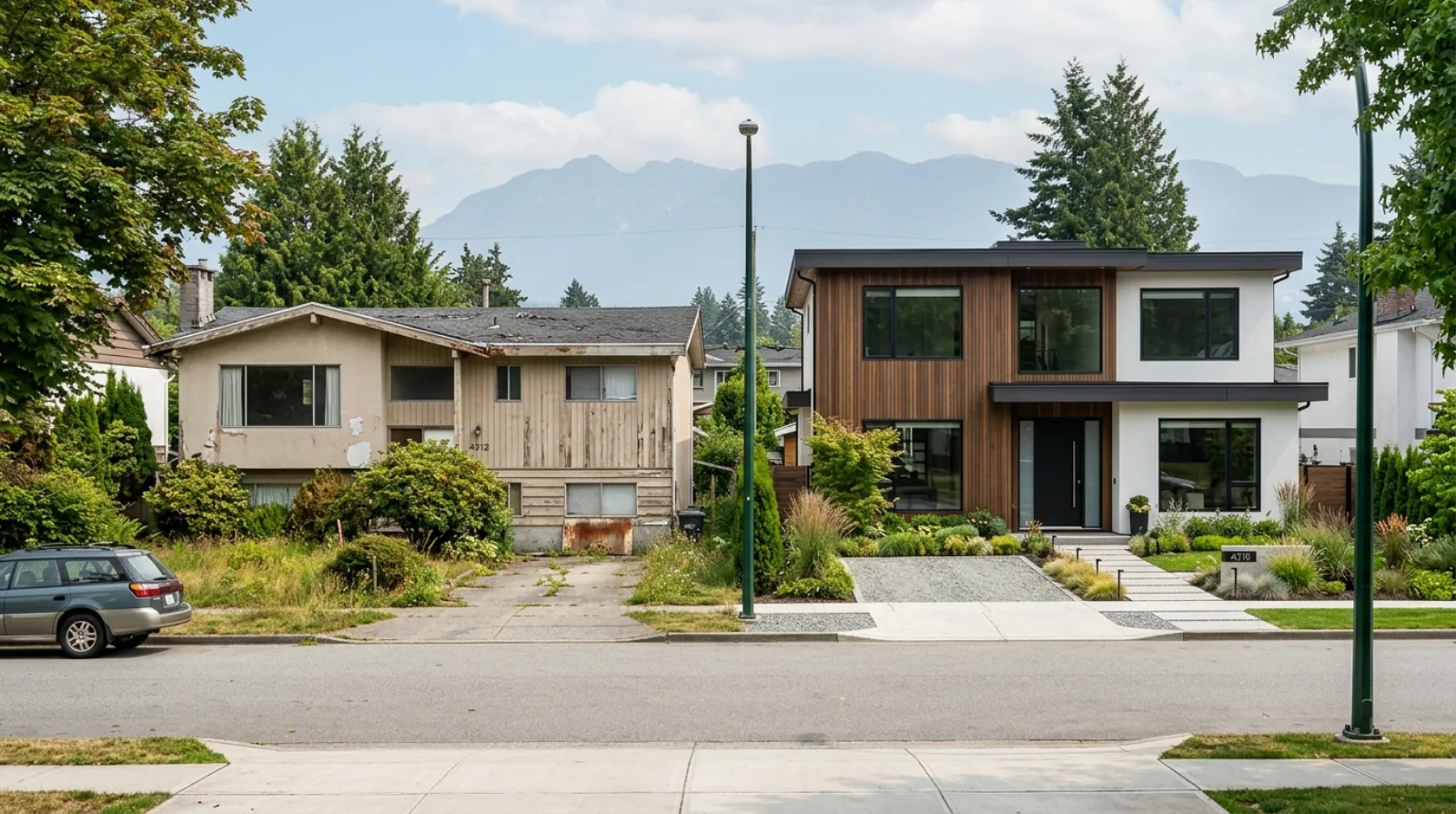
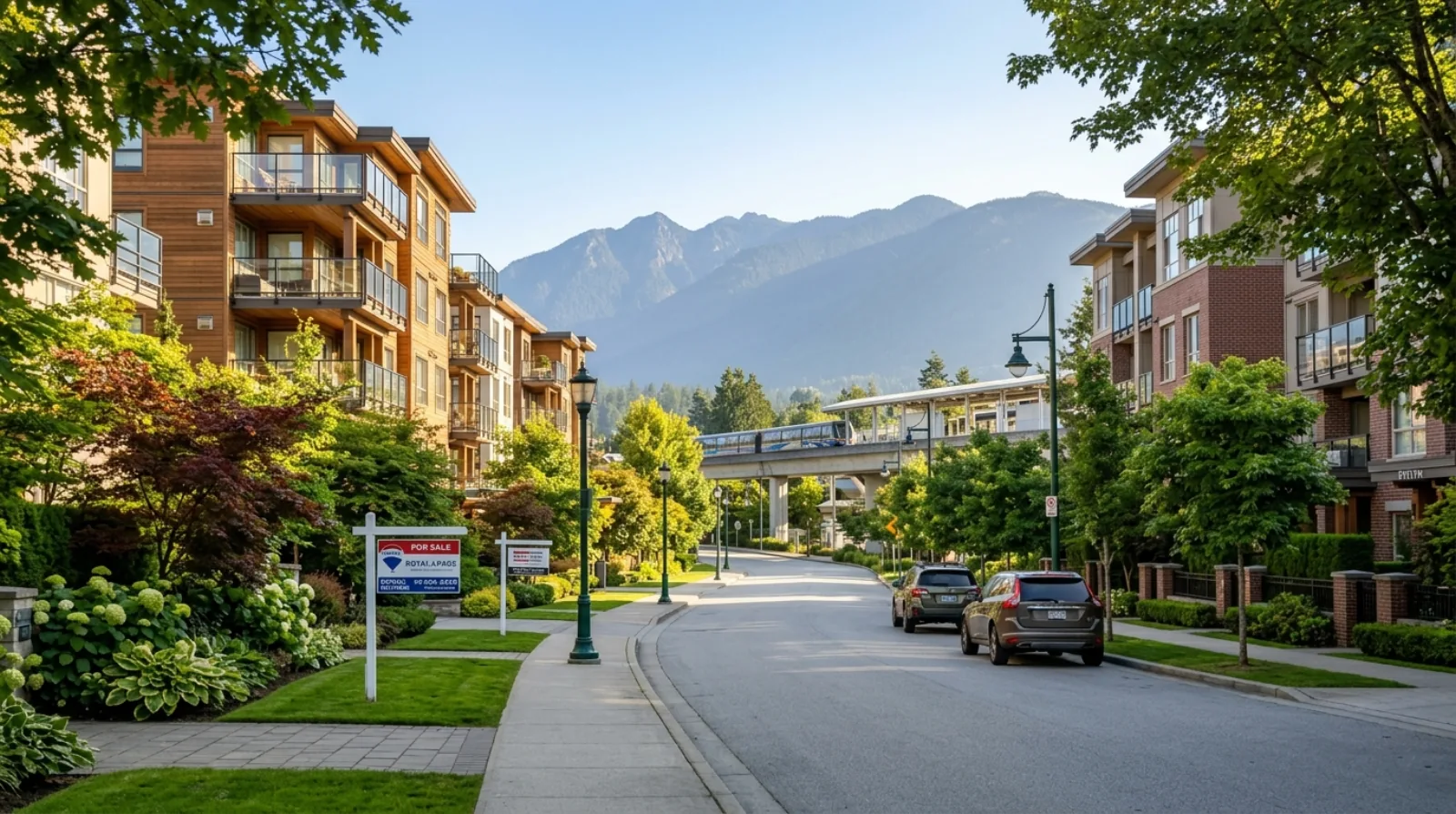
If you want to understand why one Burnaby lot sells to a builder for a premium and the lot two doors down does not, look at a map of the transit stops, not the houses. Burnaby's multiplex rules hinge on a distance most owners have never measured: 400 metres. Whether your lot sits inside or outside that circle can be the single biggest factor in what it is worth under the new zoning.
For the full rulebook, the R1 SSMUH zoning guide lays out all three unit tiers. This post is about the one line that does the most work.
What the 400 metres actually gates
Under BC's Bill 44, Burnaby's R1 zoning sets unit minimums by lot size: three units on lots up to 280 square metres, four units on lots larger than that. But there is a third tier, and it is the one builders chase. A lot of at least 281 square metres that sits within 400 metres of frequent transit must be permitted up to six units.
"Frequent transit" is a specific thing, not just any bus stop. The province defines it as a stop served, on average, at least every 15 minutes between 7 a.m. and 7 p.m. on weekdays. In Burnaby that means the SkyTrain stations and the busier bus corridors — and your lot has to be within 400 metres of one of them. Four hundred metres is roughly a five-minute walk. Miss it by a block and your ceiling drops from six units to three or four.
That is the whole mechanism. A circle, drawn around qualifying stops, that doubles the unit ceiling for the lots inside it.
Why the line moves price, not just unit count
Two more units is the obvious effect. The less obvious one is financing, and it is bigger than people expect. As I explain in the post on how owners finance a multiplex, CMHC's MLI Select program — the one that unlocks longer amortization and better terms for a rental hold — requires a minimum of five units. Below the transit line, on a four-unit lot, you cannot reach it. Inside the line, a five- or six-unit build can. So the 400-metre circle does not just add saleable homes; for an owner who wants to hold rental income, it can change the entire financing structure of the project.
Stack those together and you get the price gap. A builder underwriting a lot inside the circle is modelling six units and potentially a stronger financing path. A builder looking at the lot outside it is modelling four units and conventional financing. Same street, different math, different offer.
The SkyTrain overlay that goes further
There is a second, larger circle worth knowing about if you are genuinely close to a station. BC's Transit-Oriented Development Areas policy, under Bill 47, reaches up to 800 metres around rapid-transit stations and 400 metres around bus exchanges — and can unlock far more density than the six units SSMUH allows. SSMUH and TOD are separate programs. Close to a SkyTrain station, it may be the TOD rules, not R1, that set your real ceiling. This is part of why the blocks around Burnaby's transit cores — places like Brentwood becoming a district and the Lougheed–Burquitlam corridor — are repricing fastest.
A real-world example: Edmonds SkyTrain
I use Edmonds when I walk owners through this, because it is one of the clearest illustrations of how the circle plays out on a real street grid.
The Edmonds SkyTrain station sits at Kingsway and 10th Avenue in southeast Burnaby. Draw a 400-metre radius around the station entrance, and you get a circle that takes in several blocks in every direction. On the north side, Humphries Avenue and parts of 11th and 12th Avenue fall comfortably inside the circle. On the south side, the boundary crosses roughly through the 6100-block of McKay Avenue, depending on exact lot position.
The blocks that land inside the circle are working with a six-unit ceiling on a qualifying lot. The blocks that fall just outside are working with three or four. A row of similar lots on the same street can straddle that line. Two neighbours with identical house styles, similar lot sizes, and almost identical assessed values can have meaningfully different development values because one is at 380 metres and the other is at 420 metres. This is not hypothetical. It is the pattern I see when I pull land sales in Edmonds and Brentwood and compare them against station proximity.
For Burnaby's other transit nodes, the same logic applies. Brentwood Town Centre on the Millennium Line, Metrotown and Lougheed Town Centre on their respective lines, and the Expo Line stops in south Burnaby each have their own 400-metre circles. Lots near Edmonds station that sit inside the radius have been receiving builder attention for the same reason.
The frequently-qualifying bus corridors in Burnaby include Hastings Street (Route 14 and others), Kingsway (Routes 19, 22), and Marine Drive — but route frequency changes seasonally and schedules are adjusted periodically. Always confirm the current qualifying-stop list against TransLink's official schedule data rather than assuming any given bus route meets the 15-minute daytime threshold.
How to find your line
You do not need a planner to get a first read. Pull up a map, find the nearest SkyTrain station or frequent bus stop, and check whether your lot is within about a five-minute walk. If it is, and your lot is over 280 square metres, you are likely in the six-unit tier — and possibly inside a TOD area with even more potential. If you are clearly outside it, plan around three or four units.
Then confirm it properly. Walking-distance estimates are not the legal measurement, and the qualifying-stop list matters. The Burnaby Zoning Bylaw and Official Zoning Map is the authoritative source, and the City of Burnaby's development services can confirm the specific qualifying stop for your address. The feasibility guide covers what to check next once you know which side of the line you are on.
What the line does not tell you
Knowing you are inside the 400-metre circle is step one. It is not the whole answer, and treating the six-unit ceiling as a guaranteed premium is the mistake I see most often.
The zoning permission has to meet site reality to translate into value. A lot inside the transit radius but with no lane access, a heritage-designated tree that covers a third of the build envelope, or a steep grade that requires a retaining wall structure is still a constrained site. Builders are underwriting the land against the finished project — they are not paying a standard premium for the transit location and then figuring out the site constraints later. The math has to close on your lot specifically.
The other variable is market timing. Builder demand is active in the Burnaby transit corridors right now, but land acquisition pacing changes with financing conditions and pre-sale appetite. A lot inside the radius in a softer period may attract fewer competing builder offers than the same lot when the condo market is running hot. The 400-metre line sets the ceiling; conditions at the time of sale determine how much of that ceiling you actually capture.
That is why I run a feasibility read before any pricing or listing conversation for a Burnaby detached lot. The transit position is one input in a multi-variable calculation, not a valuation shortcut.
Key Takeaways
- Lots over 280 square metres within 400 metres of frequent transit can reach six units; outside that radius, the ceiling is three or four.
- "Frequent transit" means a stop served on average every 15 minutes daytime — SkyTrain and busy bus corridors, not every stop.
- The line changes financing, not just unit count: five-plus units near transit can open CMHC MLI Select, which a four-unit lot cannot reach.
- Close to a SkyTrain station, BC's separate Transit-Oriented Development Areas rules may set a higher ceiling than SSMUH.
- Check the nearest qualifying stop and your lot size first, then confirm against the current Burnaby Zoning Bylaw.
Frequently Asked Questions
How do I know if my Burnaby lot is within 400 metres of frequent transit?
Find the nearest SkyTrain station or frequent bus stop and check whether your lot is within about a five-minute walk. That is a rough first read; the legal measurement and the list of qualifying stops should be confirmed against the City of Burnaby's zoning resources before you rely on it.
What is "frequent transit" for the six-unit rule?
The province defines it as a stop served, on average, at least every 15 minutes between 7 a.m. and 7 p.m. on weekdays. In Burnaby that covers SkyTrain stations and the busier bus corridors, not every bus stop.
Why is a lot near transit worth more for development?
It can reach six units instead of three or four, and crossing five units can open CMHC MLI Select financing for a rental hold. More units plus a potentially stronger financing path is why builders pay a premium for lots inside the transit radius.
Is the 400-metre rule the same as Transit-Oriented Development Areas?
No. SSMUH's 400-metre frequent-transit rule and BC's Transit-Oriented Development Areas (TOD) are separate programs. TOD reaches up to 800 metres around rapid-transit stations and can allow far more density. Close to a SkyTrain station, the TOD rules may set your ceiling instead of R1.
Sources
- Government of BC - Small-Scale Multi-Unit Housing (Bill 44)
- Government of BC - Transit-Oriented Development Areas (Bill 47)
- City of Burnaby - Zoning Bylaw 4742 & Official Zoning Map
Policy details current as of June 2026 and subject to change. Walking-distance estimates are not the legal measurement. Verify your property's transit eligibility and current zoning with the City of Burnaby before making any decision.
Work With Jersey Li
The 400-metre line is invisible from the curb, but it can be the difference between a four-unit lot and a six-unit one — and the financing that comes with it. I help Burnaby owners find exactly where their lot sits and what that means for value, before they price or develop it.
Call or text Jersey Li at 604.942.7211, get in touch, or read the full multiplex development guide.

Sutton Group — 1st West Realty · Medallion Club Member (Top 10%)
Burnaby real estate advisor and multiplex strategist. Licensed REALTOR® with Sutton Group — 1st West Realty, specializing in residential, multiplex, and redevelopment transactions across Burnaby and Metro Vancouver.